Try a FREE tutoring session with your student!
$50.00 Sibling Discount Available! *Terms Apply
Dear Parent(s), I hear you loud and clear, and I have the answers!
In Atlanta Public Schools (APS), parent and teacher complaints regarding the Geometry curriculum—specifically the Geometry: Concepts and Connections course—often center on the transition to new state standards and the lasting impact of the "integrated" math debate.
As of the 2025–2026 school year, the following are the primary areas of concern:
1. The Complexity of the "New" Math Standards
Georgia recently revamped its K-12 Mathematics Standards to emphasize flexible thinking and real-world application over rote memorization.
The Burden on Students: Parents often complain that the standards are overly demanding, requiring students as early as 5th grade to analyze complex shapes like rectangular prisms before they have fully mastered foundational arithmetic.
Lack of Mastery Time: Teachers and parents have noted that because the curriculum is rigorous and fast-paced, there is often not enough time to teach to mastery, leaving students who struggle "in the dust".
2. Disconnect in Instructional Methods
A recurring complaint involves the gap between how teachers were trained and how they are now required to teach.
Instructional Style: Parents have expressed frustration that while students are encouraged to "think flexibly," many teachers are still adjusting to these new methods, leading to inconsistent classroom experiences.
Avoidance of Proofs: Some geometry teachers reportedly avoid teaching complex proofs due to a lack of confidence in the new standards or the belief that students struggle too much with abstract reasoning.
3. Integrated vs. Traditional Pathways
The debate over Integrated Math (mixing Algebra, Geometry, and Statistics) vs. Traditional Math (discrete year-long courses) remains a point of contention in Georgia.
Teacher Preferences: Surveys have shown that many Georgia high school teachers prefer a traditional approach, specializing in either Algebra or Geometry rather than trying to teach both in an integrated format.
Parental Skepticism: Parents often view the integrated model as confusing or "watered down," though state assessments continue to use the integrated model for high school testing.
4. Grading Policy Controversies
A specific point of tension in APS has been the district's grading policy, which includes a minimum score of 50 even for uncompleted work.
"Numbers Over Students": Parents have voiced concerns that such policies prioritize graduation rates over actual learning, with some comparing it to past "cheating scandals" in the district.
5. Inequitable Access and Support
Parents in historically underserved neighborhoods have raised alarms about inequitable access to resources.
Loss of Individualized Instruction: Recent 2025 meetings regarding school closures and redistricting highlighted parental fears that consolidated schools will result in larger class sizes and a loss of the individualized instruction necessary for difficult subjects like Geometry.
What a master tutor will do as your student’s tutor?
Be a private teacher to your student and give them one on one attention to their learning needs in Geometry.
Master the geometry standards in Atlanta with Tutor Charlotte Inc. Using the rigorous Glencoe Geometry (2018 Edition) curriculum, our personalized tutoring prepares students for success in 2025-2026 by building deep conceptual understanding of:
Geometric Foundations: Mastery of points, lines, planes, and inductive/deductive reasoning.
Transformational Geometry: North Carolina's "21st-century approach" using rotations, reflections, and dilations to understand congruence and similarity.
Polygons & Circles: In-depth study of triangles (including trigonometry), quadrilaterals, and circle properties.
Coordinate Algebra: Using the Cartesian plane to prove geometric theorems algebraically, a core requirement for NC Math 1 and 2.
EOC Readiness: Adaptive instruction using LearnSmart® technology to target skill gaps and build retention for the End-of-Course (EOC) test.
Led by master tutor Dr. Kevin L. Powell, a mathematician and physicist with 30 years of experience, we provide expert support tailored for all learners, including students with ADD/ADHD.
Empower your student to become an independent thinker—complete the Tutor Charlotte Student Application today!.
Why every student should have an affordable academic tutor to help them achieve academic success!
Imagine your child having a professional master tutor to help them do the following:
Help with homework daily.
Help preparing for quizzes, tests, and exams.
Time management skills.
Reading comprehension practice.
Learn advance math skills beyond their grade level.
Learn study skills so they become independent learners.
Learn test taking technique, critical reading skills, and analytical reasoning.
Improve the student’s grades by identifying academic weaknesses and teaching your student the academic concepts they find difficult.
Long-term preparation for high SAT/ACT scores.
We offer the following in our academic tutoring programs:
Live 1 on 1 tutoring sessions 7 days a week.
Help with math and English grammar homework daily.
Flexible tutoring schedules for the busy student.
Comprehension practice quizzes, tests, and exams to prepare your student for school.
A pathway to a college or university with long-term academic preparation.
Meet Your Student's Private Professor: Dr. Kevin L. Powell, Mathematician, Physicist, Logician, and Writer
Experience the difference that expert, one-on-one attention makes.
At Tutor Charlotte, your student receives personalized guidance from Dr. Kevin L. Powell, an esteemed educator dedicated to understanding and addressing your student’s unique learning issues with patience, understanding, and humor.
Dr. Powell inspires and motivates students to learn as much as possible, providing the dedicated attention they need and deserve.
A Remarkable Educational Background
Dr. Powell brings a wealth of knowledge and expertise to the classroom:
Doctorate in Mathematics
Master’s Degrees in: Business Administration, Economics, and Physics
Bachelor’s of Science Degree in: Business Administration
Associate’s of Applied Science Degree in: Accounting
In addition to his extensive academic credentials, Dr. Powell is an esteemed logician with two years of specialized study in logic, ensuring a structured and comprehensive approach to teaching complex subjects.
The Questions
1. Do you have any homework that I can help you with today?
2. Do you have a quiz, test, or exam this week I can help you prepare for?
3. Do you need a lesson on a particular concept your teacher taught that you did not understand?
4. What did your math teacher teach you today?
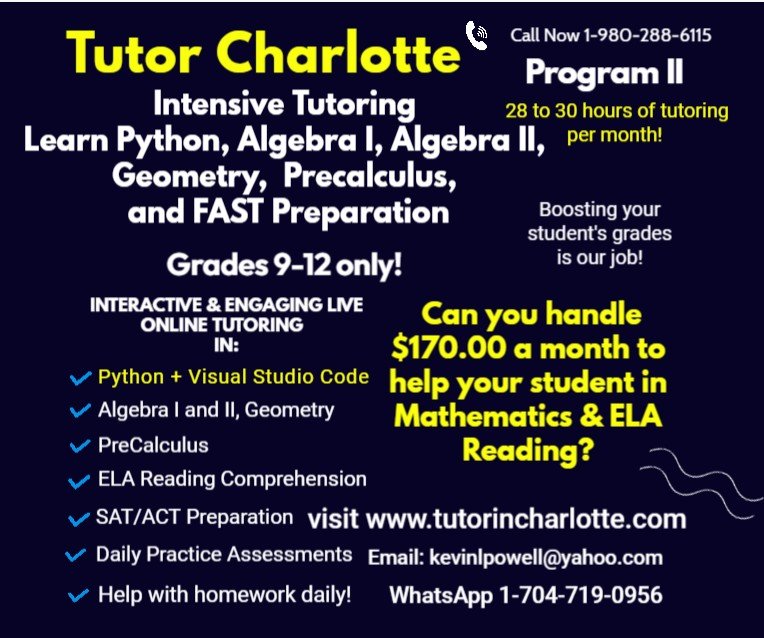
Tutor Charlotte Program II: Deep Mathematics & Language Arts + Tech Support Grades 9-12 Tutoring All Year Long Cost $170.00 per month!
Elevate your high schooler’s academic performance with Tutor Charlotte Program II, an intensive online tutoring solution designed for students in grades 9 through 12. For 2026, we have expanded our curriculum to include essential 21st-century technology skills alongside our core academic support.
Program Highlights:
Deep Mathematics: Expert instruction covering Math I, II, & III, Basic Algebra, Algebra I & II, Advanced Algebra, Precalculus, Geometry, Trigonometry, Calculus, and Set Theory and Logic (Thinking Mathematically!).
Language Arts Mastery: Comprehensive support for English grammar, reading comprehension, and composition with preparation for the SAT/ACT.
New for 2026 – Tech Literacy-The Next Gen Advantage: Students now receive introductory lessons in Python programming and Visual Studio Code, teaching them to write, debug, and execute code in a professional development environment. Python Programming Integration
High school students now receive foundational lessons in Python Programming. This addition bridges the gap between advanced mathematics and technological application, teaching students how to:
Automate complex mathematical calculations and logic problems using code.
Understand core programming concepts like variables, loops, and functions.
Apply computational thinking to solve real-world problems and prepare for future STEM careers.
Science Integration: Optional add-on of one science subject (Chemistry, Physics, or Biology) featuring a 30-minute weekly lecture and assessments.
History Enrichment: Access to specialized lectures in American and World History via the Tutor Charlotte YouTube Channel Youtube.com/@Tutor-the-Entire-World-Dr.
Schedule & Investment:
Intensity: 28 to 30 hours of academic tutoring per month.
Availability: Intensive online sessions available 7 days a week.
Customization: Lessons follow the specific curriculum guides and standards of your student’s school.
Cost: $170.00 per month
Ensure your student is prepared for college and beyond by mastering both traditional core subjects and modern technical skills. Enroll now at Tutor Charlotte to secure your student's spot for the 2026 academic year.
*A one-time non-refundable registration fee $100.00 and one-time non-refundable orientation tutoring class fee $26.06 apply. *After the orientation tutoring class, a parent can get a complete refund of the program fee $170.00, registration fee $100.00, and orientation fee $26.06 if they cancel their student’s enrollment in Tutor Charlotte within 24 hours.
There is no contract. There is no obligation to continue. You pay month to month only. You can stop academic tutoring anytime.
Professor: Dr. Kevin L. Powell, Mathematician and Physicist
Ph. 980-288-6115 Charlotte, NC
Ph. 704-719-0956 U.S. Whatsapp
Ph. 809-489-5760 D.R. Home Phone
Office Hours: 8:00 a.m. to 3:00 p.m. No phone calls will be accepted when tutoring is being done.
Compare our Tutor Charlotte flat price $170.00 a month to our competitor Sylvan Learning Center. They charge you:
Personalized Tutoring and Homework Help: $50+ per session
ACT and SAT Group Classes: $900+ per class
STEM & Academic Camps: $200+ per camp
Compare our Tutor Charlotte flat price $170.00 a month for 28 to 30 hours of tutoring to our competitor Huntington Learning Center. Their customer complained “They provide a diagnostic and then tell you they will need 80 sessions with your child, at $70-$85 per hour. I contracted for 20 sessions to see how it went before committing to more, then I was told they still need to "learn" my child. Ridiculous! My daughter was bored after 10 sessions, we stopped after 13 and I asked for a credit for the unused hours.”
Will the master tutor, Dr. Kevin L. Powell, contact my student’s teachers?
Yes, if given permission by a parent. I like to work closely with the student’s teacher in order to get the best result for your student. Click “Academic Permission Form” and print it out. Complete the form and give it to each teacher who should be contacted by the tutor.
Question: What is a typical Tutor Charlotte tutoring session like?
During the tutoring session, we ask the student the following questions and tutor what the student needs:
1. Do you have any homework that I can help you with today?
2. Do you have a quiz, test, or exam this week I can help you prepare for?
3. Do you need a lesson on a particular concept your teacher taught that you did not understand?
4. What did your Language Arts teacher, math teacher, and or science teacher teach you today?
Question: Do I need a desktop computer for my student?
Yes, your student must have access to the internet, speakers on their computer, and I recommend access to a working printer to printout academic work. I recommend a desktop computer over Ipads and other devices.
Do you do academic assessments of your students?
Yes, my students do continuous academic assessments in math and English grammar to determine the student’s skills in the subject being tutored. The continuous academic assessment allows us to adjust your student’s academic tutoring to fit their needs.
Question: Do you tutor ELA?
After a careful assessment of the student’s English grammar skills, the student is taught by the master tutor, Dr. Kevin L. Powell, using the Glencoe Language Arts English Grammar and Composition Handbook with complete assessment questions in each chapter based on the reading level of the student. In addition, the student will begin studying and incorporating 5,014 SAT vocabulary words for reading comprehension. The student is continuously tested to measure their academic progress. The student is taught English composition (writing and structure).
6th Grade English Grammar and Composition Handbook
7th Grade English Grammar and Composition Handbook
8th Grade English Grammar and Composition Handbook
9th Grade English Grammar and Composition Handbook
10th Grade English Grammar and Composition Handbook
11th Grade English Grammar and Composition Handbook
12th Grade English Grammar and Composition Handbook
Dr. Kevin L. Powell tutors and teaches mathematics strictly from the textbooks.





For the 2025–2026 school year, Atlanta Public Schools (APS) follows the Georgia K-12 Mathematics Standards, specifically the course titled Geometry: Concepts and Connections. This curriculum transitioned from the older Georgia Standards of Excellence (GSE) to emphasize mathematical modeling and real-world application.
Core Curriculum Topics
The high school Geometry curriculum is organized into "Big Ideas" that integrate geometric, algebraic, and statistical reasoning:
Geometric and Spatial Reasoning: Includes rigid motions, transformations (reflections, rotations, translations, dilations), similarity, and congruence.
Circle Properties: Exploration of circle theorems, arc length, area of sectors, and the relationship between pi, radius, and diameter.
Trigonometry: Right triangle trigonometry, including sine and cosine of complementary angles, the Pythagorean Theorem, and special right triangles.
Measurement and Modeling: Informal arguments for geometric formulas (dissection, Cavalieri's principle), volume of 3D objects (prisms, cylinders, cones, spheres), and identifying cross-sections.
Algebraic Connections: Applying polynomial expressions to geometric problems and using coordinate geometry for distance, midpoint, and slope.
Probabilistic Reasoning: Analysis of conditional probability, compound events, and two-way frequency tables.
Course Structure and Assessments
Placement: Geometry is typically the second course in the high school math sequence, following Algebra: Concepts and Connections.
Course Options: APS offers on-level Geometry and Honors Geometry, the latter of which involves more complex deductive proofs and deeper conceptual exploration.
Grading and Exams: Many courses include a Georgia Milestones End of Course (EOC) assessment, which historically accounts for roughly 20% of a student's final grade.
Mathematical Practices: The curriculum requires students to use tools like Desmos or GeoGebra and emphasizes critical thinking through 8 specific Mathematical Practices, such as persevering in problem-solving.
