English Grammar Test 6th Grade
41. The __________of a verb expresses action or a condition that is continuing at some time in the present.
past progressive form
past tense
future perfect tense
present progressive form
future progressive form
42. The __________ of a verb expresses action or a condition that was continuing at some time in the past.
past progressive form
past tense
future perfect tense
future tense
present progressive form
43. The __________ of a verb expresses action that happened at an indefinite time in the past.
future tense
present perfect tense
present progressive form
future perfect tense
past progressive form
44. The __________of a verb expresses action that happened before another action or event in the past.
past progressive form
past perfect tense
future perfect tense
present progressive form
passive voice
45. The _________ of a verb expresses action that will take place in the future.
future tense
past perfect tense
past progressive form
past tense
passive voice
46. The _________ of a verb expresses action that will be complete before another future event begins.
future tense
past progressive form
past perfect tense
future perfect tense
past tense
47. A verb is in the ________ when the subject performs the action of the verb.
active voice
past perfect tense
passive voice
past tense
future tense
48. A verb is in the _________ when the subject receives the action of the verb
action voice
past perfect tense
past tense
passive voice
future tense
49. Words that takes the place of one or more nouns.
possessive pronouns
object pronouns
relative pronouns
pronouns
subject pronouns
50. Pronouns that refer to people or things are called ___________.
subject pronouns
reflexive pronouns
personal pronouns
object pronouns
pronouns
Literary Terms
What is a Colloquialism?
At its simplest, a colloquialism is a word, phrase, or pronunciation that is informal and specific to a particular region or group of people. Think of it as the way people actually talk, as opposed to the more formal, polished language you might find in textbooks or official documents. It’s the difference between saying “I am going to eat” and “I’m gonna grab a bite.”
Colloquialism Definition
A formal definition of colloquialism is a construction or expression of language that is characteristic of ordinary or familiar conversation rather than formal speech or writing. They add color, authenticity, and a sense of realism to writing.
Simple Colloquialism Examples
Here are a few quick examples to illustrate the point:
Instead of “I will,” you might say “I’ma.”
Instead of “you all,” you might say “y’all.”
Instead of “are you going to,” you might say “gonna.”
Instead of “did not,” you might say “didn’t.”
These are all examples of how we shorten words and use contractions in everyday speech, making our language more relaxed and natural.
While formal writing often discourages colloquialisms, skilled writers can use them intentionally to achieve various effects. Here’s how:
Creating Realistic Dialogue
Perhaps the most common use of colloquialisms is to make dialogue sound natural and authentic. Characters shouldn’t always speak in perfect, grammatically correct sentences. Using colloquialisms can help them sound like real people.
Example:
“Well, I reckon that was a pretty good show,” said Old Man Hemlock, adjusting his cap.
The phrase “I reckon” is a colloquialism common in certain regions, immediately giving the character a distinct voice and background.
Establishing Setting and Character
Colloquialisms can be highly regional. A character who says “wicked” to mean “good” is likely from New England. Similarly, using phrases like “fixin’ to” indicates a Southern origin. This helps establish the setting and background of your characters.
Example:
“I’m just headin’ over yonder to grab a pop,” she said with a drawl.
The use of “yonder” and the Southern drawl quickly paint a picture of the character’s location and upbringing.
What is Caricature? A Simple Definition
At its core, caricature is the exaggeration of a subject’s distinctive features or personality traits for comedic or satirical effect. While frequently associated with visual art, think of political cartoons, it’s equally potent when employed in writing. The goal isn’t necessarily to create a realistic portrayal, but rather a heightened, often humorous, version of a person or idea. It’s about focusing on what makes someone recognizable and then amplifying those characteristics.
Several techniques contribute to the creation of effective caricatures. Understanding these will help you both recognize and create them.
Exaggeration
This is the cornerstone of caricature. It involves amplifying specific physical or personality traits beyond their normal proportions. Consider a character who is naturally clumsy. A caricature might have them constantly tripping over thin air, breaking objects with minimal contact, and apologizing profusely even for things that aren’t their fault.
Simplification
Caricature often involves stripping away unnecessary details. This focuses attention on the most prominent or defining features. If describing a character with a large nose, a caricature wouldn’t dwell on the shape of their eyebrows or the color of their eyes. It would only focus on the nose, perhaps describing it as “a magnificent beak” or “a looming promontory.”
Emphasis on Distinctive Features
What makes a person unique? A particular walk? A peculiar habit? A memorable vocal inflection? Caricature highlights these distinguishing characteristics. Imagine a character who always speaks in questions. A caricature might have every sentence phrased as an inquiry, even simple statements like “It’s raining, isn’t it?” or “I went to the store, didn’t I?”
Juxtaposition
Placing contrasting traits together can create a humorous caricature. A powerful, imposing general who is terrified of kittens, or a renowned philosopher who obsessively collects rubber ducks, these incongruities can be highly effective.
What is Amplification?
Amplification is a literary device used to enhance or exaggerate a statement for emphasis. It involves repeating a word or phrase, or adding more detail to it, to increase its significance. Think of it like turning up the volume on an important idea. It’s not just about saying something; it’s about really making it stand out.
Instead of saying “She was sad,” you might say “She was utterly, completely, devastatingly sad.”
Rather than “He ran quickly,” try “He ran with incredible speed, a blur against the landscape, faster than the wind itself.”
Instead of “It was a good movie,” you could say “It was a truly magnificent, breathtaking, unforgettable movie!”
Notice how the added words and phrases don’t just repeat the initial idea; they expand on it, adding layers of meaning and emotional weight.
How Does Amplification Work?
Amplification operates on several levels. It’s not simply about adding adjectives; it’s about strategically expanding on a core idea to create a particular effect. Here are some of the key ways writers employ amplification:
Repetition
Repeating a word or phrase is a common form of amplification. This repetition doesn’t just reinforce the idea; it can create a rhythm and build emotional intensity.
Example: “Government of the people, by the people, for the people, shall not perish from the earth.” – Abraham Lincoln. Here, the repeated phrase “of the people” emphasizes the core democratic principle at the heart of his message.
Elaboration & Detail
Adding details, explanations, and supporting information amplifies a statement by providing a more comprehensive picture. It transforms a simple assertion into a richer, more nuanced one.
Example: “He was angry.” becomes “He was angry, his face flushed crimson, his hands clenched into fists, a storm brewing in his eyes that promised a terrible reckoning.” The added details paint a vivid picture of his anger, making it far more impactful.
Exaggeration & Hyperbole
While not always strictly amplification, exaggeration can often be used as a tool for amplification. Hyperbole, the use of obvious exaggeration, can emphasize a point by making it seem larger than life.
Example: “I’m so hungry I could eat a horse.” This is an obvious exaggeration, but it powerfully conveys the speaker’s extreme hunger. The amplification comes from taking a simple feeling and escalating it to an absurd degree.
What is an aside?
An aside is a brief remark a character makes that is intended for the audience to hear but not for other characters on stage (in a play) or within the story’s world (in literature). Think of it as a character briefly stepping outside of the action to share their true feelings, opinions, or plans directly with you. It’s a way for the writer to reveal information the character wouldn’t normally share aloud.
Quick Examples of Asides
“Oh, if only she knew what I really think of her new hat!”
“I’m sure this plan will fail spectacularly, but what choice do I have?”
“He seems nice, but I suspect he’s hiding something.”
These short statements, delivered as asides, immediately create a connection between the character and the audience, offering insight that isn’t available to the other characters.
What is an audience?
The audience is the intended recipient of a communication. It’s the group of people a writer or speaker is trying to reach, influence, or entertain. Identifying the audience is one of the very first steps a communicator takes.
Here are a few straightforward examples:
A children’s book: The audience is young children, who are usually accompanied by a parent or teacher.
A scientific paper: The audience is other scientists and researchers in the same field.
A political speech: The audience is voters or constituents.
A pop song: The audience is generally the public, but often skews toward a specific age group or musical preference.
What is an asyndeton?
Asyndeton (pronounced a-SIN-de-ton) comes from the Greek meaning “without conjunction.” Simply put, it’s the omission of coordinating conjunctions, words like and, but, or, nor, for, so, and yet, between clauses, phrases, or words in a list. Instead of fully connecting elements, asyndeton creates a sense of quickness, compression, and even urgency. It’s a stylistic choice that can significantly impact the pace and emotional effect of a text.
A Quick Example of Asyndeton
Consider these two sentences:
“I came, I saw, I conquered.”
“I came and I saw and I conquered.”
The first sentence, using asyndeton, feels far more direct, forceful, and memorable. The absence of “and” accelerates the tempo and gives the impression of unstoppable momentum.
Why Use Asyndeton?
Asyndeton isn’t just about stylistic flair; it serves several key rhetorical purposes:
Creates a Fast Pace: Omitting conjunctions speeds up the rhythm, making the writing feel energetic and dynamic.
Emphasizes Ideas: By placing elements side by side without connective tissue, asyndeton can highlight the inherent relationship between those ideas.
Suggests a Sense of Overwhelm or Chaos: A rapid-fire list without conjunctions can mirror a character’s frantic thoughts or a chaotic situation.
Adds Impact and Memorability: The unconventional structure makes the phrase or sentence stand out.
Lesson on Adverbs
An adverb is a word/a set of words that modifies verbs, adjectives, and other adverbs. It tells when, where, and how an action is performed or indicates the quality or degree of the action.
Many adverbs end in -ly but some words which end in -ly (such as friendly) are not adverbs. Many words can be both adverbs and adjectives according to their activity in the sentence.
Example:
Robin is always hungry for success.
I love her very much.
He is running fast.
Alex works hard.
He wrote that willingly.
Adverb Clauses and Adverb Phrases are clauses and phrases that modify the verbs, adjectives or other adverbs in the sentence.
Example:
He ran toward the bus until he was tired. (Adverb Clause)
He came carrying his box with two hands. (Adverb Phrase)
We were panicked without any reason. (Adverb Phrase)
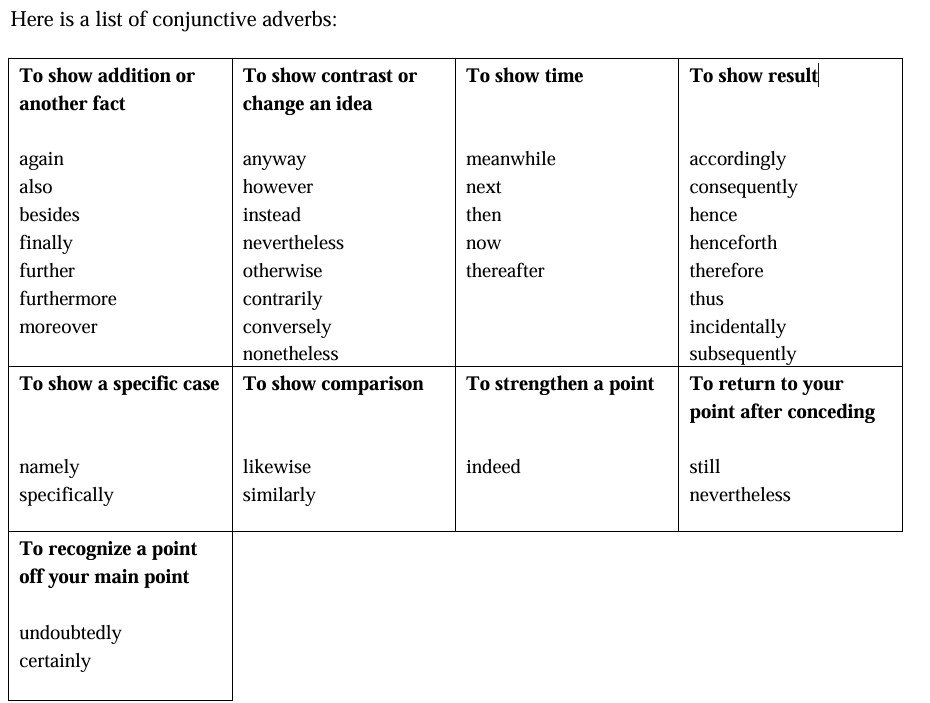
A conjunctive adverb connects phrases or independent clauses. It provides transitions between ideas and shows relationships.
Conjunctive adverbs are also called connectors.
Example:
It rained last night. Nonetheless, the final match has not been canceled.
We are still confused, however, if the umpires will come.
Last season there was a great drought; consequently, we could not grow crops.
Sentence Adverbs:
A sentence adverb starts the sentence and modifies the whole sentence.
Example:
Hopefully, we will win the match.
Apparently, the sky is getting cloudy.
Certainly, I did not think of coming here.
Adverbs of time/frequency indicate time or frequency of the action in the sentence. They answer the question ‘when/how frequently is the action performed?’.
Always, never, often, eventually, now, frequently, occasionally, once, forever, seldom, before, Sunday, Monday, 10 AM, 12 PM, etc. are common adverbs of time/frequency.
Example:
I went to school a little late yesterday.
He always gets a good result.
I will leave Monday.
He smokes occasionally.
Adverbs of Place/Direction (Where?)
Adverbs of place/direction that indicate place/direction of the action in the sentence. They answer the question ‘ where is the action performed?’.
Across, over, under, in, out, through, backward, there, around, here, sideways, upstairs, in the park, in the field, in that place, etc. are some common adverbs of place/direction.
Example:
I went through the jungle.
He plays in the field.
Alex is going to school.
He is staying at my home.
Adverbs of Degree (How Much?)
Adverbs that express the importance/degree/level of the action in the sentence are called adverbs of degree. They answer the question ‘how much is the action performed?’.
Completely, nearly, entirely, less, mildly, most, thoroughly, somewhat, excessively, much, etc. are common adverbs of degree.
Example:
She completely forgot about her anniversary.
I read the newspaper thoroughly.
I am so excited about the new job.
Robin hardly studies
Adverbs of Manner (How?)
Adverbs that express the manner/approach/process of the action in the sentence are called adverbs of manner. They answer the question ‘how is the action performed?’.
Beautifully, equally, thankfully, carefully, handily, quickly, coldly, hotly, resentfully, earnestly, nicely, tirelessly, etc. are common adverbs of manner. These adverbs usually end in ly.
Example:
Let's divide the prizes equally.
Please, handle the camera carefully.
Mike is walking slowly.
He is running fast.
Adverbs are words that modify (1) verbs, (2) adjectives, and (3) other adverbs. They tell how (manner), when (time), where (place), how much (degree), and why (cause). Why is a common one-word adverb that tells why. Adverbs that tell us how, when, where, and why always modify the verb. Adverbs that tell us how much modify adjectives or other adverbs. These adverbs are also called qualifiers because they strengthen or weaken the words they modify. Many adverbs end with ly which is a good clue to adverb recognition, but not all words that end in ly are adverbs. Some words such as daily, yearly, hourly can be either adverbs or adjectives.
Examples:
He kicked the ball solidly. (how)
He kicked the ball immediately. (when)
He kicked the ball forward. (where)
He kicked the ball too hard. (how much)
Not and its contraction n't are adverbs. They really modify the entire sentence, but we will have them modify the verb as it is the most important word in the sentence. This is a common practice in grammar books. Remember that adverbs tell us how, when, where, why, and how much and modify verbs, adjectives, and other adverbs.
Adverbs may be compound. Example: He speaks rapidly and well.
Adverbs that tell us how, when, and where can shift position in the sentence.
Examples:
I am often out of town.
Often I am out of town.
I am out of town often.
Most adverbs
are formed from adjectives. Many adverbs are formed by adding ly to the adjective.
Example:
slow - slowly
Most adjectives that end in y change the y to i and then add the ly to form the adverbs.
Example:
lazy - lazily
Most adjectives that have more than one syllable and end in le simply change the e to y to form the adverbs.
Example:
favorable - favorably
Most adjectives ending in ic add ally to form the adverbs.
Example:
basic - basically
Not all adverbs are formed from adjectives. Some common ones are never, not, here, there, then, when, where, always, too, now, and very. Remember that adverbs tell us how, when, where, why, and how much and modify verbs, adjectives, or other adverbs.
Adverbs like adjectives can be compared. They have the same three degrees (1) positive - one thing or person, (2) comparative - two things or persons, and (3) superlative - more than two things or persons. Most adverbs formed from adjectives use more or most to express comparisons.
Example:
slowly, more slowly, most slowly
Some adverbs, including those that can also be adjectives, use er and est to form comparisons.
Example:
soon, sooner, soonest
Some adverbs have an irregular comparison.
Example:
well, better, best
Most adverbs not formed from verbs cannot be compared. Words like now, too, then, not, already, again, always, yesterday, almost, why, and here.
Do not use two negative words to limit one idea. Be careful not to use not or n't, no, never, none, hardly, scarcely, or nothing with another negative word.
Examples:
Correct - Jim never likes help. Jim likes no help.
Incorrect - Jim never likes no help.
Correct - Barbara said nothing. Barbara didn't say anything.
Incorrect - Barbara didn't say nothing.
Adverbs are words that modify (1) verbs, (2) adjectives, and (3) other adverbs. They tell how (manner), when (time), where (place), how much (degree), and why (cause). Why is a common one-word adverb that tells why.
Adverbs that tell us how, when, where, and why always modify the verb. Adverbs that tell us how much modify adjectives or other adverbs. These adverbs are also called qualifiers because they strengthen or weaken the words they modify.
Examples:
He kicked the ball solidly. (how)
He kicked the ball immediately. (when)
He kicked the ball forward. (where)
He kicked the ball too hard. (how much)
The adjective good should not be used for the adverb well. Well should be used for an adjective only when it refers to health or appearance.
The adverb badly is used to tell how something is done. The adjective bad is used to refer to health or feelings and to complete linking verbs such as seem, look, taste, smell.
